
From the outside, Rachel and James have it figured out. She runs a cardiology department. He built a software company from a spare bedroom and sold it at fifty. They both still run, both still read, and both still show up for the people they love. Their two kids are at good colleges and call home because they want to. They’re the couple who host Thanksgiving, the ones their friends quietly measure their own marriages against. When they walk into a dinner party, people sit up a little straighter.
The last time they had sex was in March. It’s October.
Neither of them has told a soul, and you’d never guess it. That’s the part I want you to sit with, because couples like Rachel and James are exactly who you’d assume have this handled. They are disciplined, intelligent and kind. If effort and intelligence could solve this, they would have solved it years ago.
They aren’t one couple, by the way. Rachel and James are a composite of many couples Dr. Saida and I have worked with, with names and details changed. If you recognize yourself in them, you’re far from the only one.
The one thing they were never taught

Everything else in Rachel and James’s life followed the same formula. Find the best teachers, learn the skill, practice it, get better. That’s how she became a cardiologist and how he built a company. It’s how they learned to run a marathon in their forties.
Sex was the one part of their life where they never had a teacher, and where nobody ever suggested they might need one.
In their twenties, they didn’t need one. Desire did all the work. They couldn’t keep their hands off each other, and the newness carried everything. Then came the kids, the careers and the mortgage, and sex became like everything else in a busy life: quick, efficient, fitted in. What they knew about sex came from the same three places most of us learned from. School gave them reproductive anatomy and a list of risks, mainly pregnancy and disease. Porn taught James the technique, which is friction: in and out, harder and faster, and the bigger the better. Magazines and the advice columns taught Rachel that her pleasure was clitoral and his was penetration, so they took turns. She came first, with his hand or a toy, and then they had intercourse, which both of them understood, without ever saying so, was really for him.
The routine worked well enough for fifteen years, even as the desire and attraction of the early days slowly faded. That part, everyone assured them, was normal. Friends joked about it over dinner. Magazines called it the natural arc of a long relationship, and the therapists and sexologists they later read said much the same: passion settles down, and the companionship that replaces it is simply the mature form of love. So nobody noticed what was actually happening, which was a slow numbing, in their bodies and between them, a little more every year. Sex got shorter, then less frequent, then mostly a weekend thing when nobody was too tired. When they talked about it at all, they talked about later. We’ll have time for us when the kids are older. When they’ve left home. When the company is sold. When we retire.
Later never arrives the way you picture it, though. Every stage of life brings its own complications, and theirs was already on its way.
Then her body changed, and the little they had been taught stopped working at all.
When her body changed and his followed
Rachel was forty-six when penetration started to hurt. It began as a burning at the entrance, then a dryness no amount of lube seemed to fix, then a deep, sharp ache when he went in at a certain angle. She didn’t say anything at first. She’s someone who finishes a marathon on a bad knee, and she treated sex the same way: she gritted her teeth and got through it. She learned to clench, to angle her hips away from the sore places, and to leave her body and go somewhere else in her head until it was over.
James felt all of it. He couldn’t have named it, but he felt her brace when he moved toward her and felt her go away while he was inside her. He read it the only way a man who loves his wife can read it: she doesn’t want me anymore. The doubt went straight into his body. More and more often he lost his erection right at the moment of entry, and on other nights the nerves took him over the edge within a minute. For a man who had never failed at anything he set his mind to, it was humiliating.
So each of them started protecting the other, by asking less often. That’s how a marriage like theirs goes quiet. Nobody stops loving anybody. Two considerate people simply decide, separately and silently, that it’s kinder not to try.
They asked the experts
Because they’re Rachel and James, they did the sensible thing and went to the professionals.
Her gynecologist told her it was common at her age, prescribed a vaginal estrogen cream and recommended a better lubricant. James got a prescription for an erection pill from an online clinic he’d seen advertised during a football game. Together they saw a couples therapist, who was warm and helpful and had them talk about their feelings, schedule date nights and remember that intimacy doesn’t have to mean intercourse. A bestselling book suggested a good vibrator and taking turns.
Every one of those suggestions was reasonable, and some of them helped. The cream eased the dryness. The pill gave James a reliable erection. The therapy got them talking again.
But look at what the advice added up to. They now had a firmer erection and a slightly less dry vagina, and they were having exactly the same sex: one person pushing, one person bracing, and both of them watching. A hard cock moving into a body that’s tensing against it still hurts. A man watching his wife’s face for signs of pain still can’t feel very much. Nobody, at any point, taught them what two bodies can actually do together once penetration has begun. That’s the part couples spend most of their sex doing, and it’s the part nobody teaches. The doctors treated the parts, the therapist treated the relationship, and porn was still the only teacher either of them had ever had for the act itself.
How it hollowed out the marriage
This is where it stops being about sex.
The kids left for college, which was supposed to be the moment they finally had time for each other. The company sold. The house went quiet, and the quiet turned out to be the loudest thing in it. Later had arrived, and it looked nothing like what they’d promised themselves.
Over the years, a marriage like this rearranges itself around the thing nobody talks about. Rachel started going to bed early with a book. James found he had email to answer downstairs, and he came up once he was fairly sure she’d be asleep. The goodnight kiss got shorter so that neither of them could mistake it for an invitation. At dinner parties they joined in on the jokes about who has the energy at our age, and both of them laughed a little too hard.
Underneath, two quiet stories grew. James’s was that she wasn’t attracted to him anymore. Rachel’s was that he wanted one thing from her and had no idea what it cost her to give it. Both stories were wrong, and both of them hardened. They became superb partners in running a life, the household, the calendar, the kids, and something close to strangers in bed. The cruelest part was that they believed this was simply what happens. Everyone says it, every friend jokes about it, even the experts told them it was normal at their age.
If you’re thirty and reading this, this isn’t a story about older people. It’s a forecast. It’s where the friction model leads when life gets full and bodies change, unless someone teaches you something different. If you’re in the middle of it right now, you already know the separate bedtimes and the short kisses, and you know how lonely it is to be admired by everyone and touched by nobody. And if you gave up on this years ago and settled for a good partnership without the sex, I want you to hear this clearly: it was never your bodies giving out. It was a skill nobody handed you.
The research that got James's attention
James was the one who found us, and he did it the way he does everything, by reading the data first. He wasn’t going to trust another promise. He wanted to see what had changed for real couples, measured properly.
What he found was the study Dr. Saida and I published in 2025 in the peer-reviewed journal Health. Forty-three couples, eighty-six people, spent eight weeks learning our Penetration Protocol, the partnered penetration application of the Suction Sex® method that 9 Naughty Nights is built on. Their overall sexual satisfaction rose 36.4%, and their personal satisfaction rose 41.6%. Women’s orgasm and arousal both improved significantly, and women’s overall sexual function rose 21.2%. Shame getting in the way of enjoyment fell by more than a quarter, and confidence as a sexual partner rose by almost a fifth. Emotional connection during sex rose 26.3%, and closeness both before and after sex rose by about a third. The couples had sex more often. Intercourse itself, which for most of them started out at under five minutes, moved toward five to fifteen, and the whole sexual experience stretched from five to fifteen minutes toward fifteen to thirty. How highly they ranked sex in their lives more than doubled.
James did what he does with any pitch and went looking for the weak points. What he found instead was a study built the way he would have wanted one built. Before a single couple enrolled, an independent ethics board, known as an Institutional Review Board, reviewed and approved it. The statistical analysis was done by two researchers from Imperial College London’s Centre for Psychedelic Research. Dr. Saida and I designed how the teaching was delivered, and we co-authored the paper so that the methods and practices would be described accurately. Then came the detail that surprised even us: many of the practices were done only once in the entire eight weeks, and some were simply a short video the couples watched.
That was the line James read out loud to Rachel. If this much changed for couples who went through the material once, what might change for two people who actually practiced it? It’s also why we call this a clinically tested method.
9 Naughty Nights
The skill nobody taught them
9 Naughty Nights teaches couples what to do during penetration: nine date nights at home, with practice videos, the why behind each one, and troubleshooting for pain, numbness and the moments your hips won't cooperate.
See 9 Naughty Nights →The first night, done differently

They started where every couple in 9 Naughty Nights starts, with the first date. They watched the lesson together on a Friday night, joking about doing homework at their age and laughing more than they’d expected to. It was short and practical, and if they were honest it gave them two things they hadn’t had in months: an excuse to have sex, and a plan for the exact moment that had been going wrong, the very beginning of penetration. For many couples that’s the most anxious part of the whole night. For Rachel and James it was where everything had been falling apart.
Then they went upstairs and tried it.
First, plenty of lube. Then, instead of James aiming and pushing, Rachel took hold of him and painted with the head of his cock: slowly along her outer lips, between them, over her clitoris, in circles around her entrance. It didn’t matter whether he was hard or soft. A soft cock still has a great deal of sensation, and many women love how it feels at the start, like soft lips kissing the vulva. For James it was the first time in years that nothing depended on his erection. Nobody was waiting for it, so he could simply feel her.
Then they stopped. He rested right at her entrance without going in. They looked at each other and breathed together, and the waiting did something neither of them expected. When one person is eager and the other needs a moment, this pause lets the two nervous systems meet in the middle. We call it steaming, because you’re bringing fire and water together. James’s anxiety had nowhere to run. Over a few breaths it turned into anticipation.
Then Rachel drew him in. As she inhaled, she gently pushed out with her pelvic floor, and as she relaxed, her body pulled him inside her at exactly the speed she wanted. James’s only job was to stay adaptive, neither pushing forward nor pulling away, and let her bring him in.
What happened in those few minutes is the heart of everything Dr. Saida and I teach. The burning at Rachel’s entrance had come from being entered before her body was ready. Now her body set the pace, so it was ready by definition. James’s erection trouble had come from fear that she didn’t want him. Now he could feel her wanting him, physically, as she drew him in. There’s something about being truly wanted, and feeling it in your body, that lights up the whole arousal system. Neither of them had to fix themselves. They had to stop doing sex to each other and start doing it together.
From friction to suction

What they were learning has a name. We call it Suction Sex®, and the core idea is that sex runs in both directions.
The friction model that porn teaches has one active partner. One person thrusts and the other receives, and the only dials are speed, force and depth. When something goes wrong in that model, the only fixes are more lube, a harder erection, or less sex.
The suction model has two active partners. The receiving partner uses her breath and her pelvic floor to draw her partner in, hold him, release him, and set the pace and the depth. The giving partner learns to be adaptive, moving from his hips instead of driving with his legs, and responding to what her body is doing instead of running a routine. One of the things couples are most surprised by is how little movement it takes. The smaller the circles, the bigger the sensation.
The pain point, and the numbness
The breakthrough Rachel talks about most came on the seventh date, the one we call the treasure hunt, or pleasure mapping.
A few weeks in, they found the deep, sharp place that had been hurting her for years. In the old days she would have curled away from it and kept going, gritting her teeth so she didn’t spoil it for him. This time she put her hand on his hip, the signal for him to stay still, and she told him. Together they found the angle and the exact pressure that met the spot without pushing into it. Then she took a deep breath into her belly and gently pushed out with her pelvic floor, which brought her right into the sensation instead of away from it, and on the out-breath she relaxed and let her voice out. They held the point of contact and did it again. Sometimes it takes three breaths, sometimes a couple of minutes. That night it took about five breaths, and then the pain was gone.
Some of the places that had been sore weren’t painful so much as numb, and numbness was the other half of her story. In many women that dull, absent feeling is what boredom in bed actually is: tissue that isn’t feeling much. When numbness starts to wake up, it often feels like irritation first, or a wriggly discomfort, before it turns into a buzz and then into pleasure. Rachel knew that was coming because the course told her, so she breathed through it instead of stopping.
Here’s the thing I’ve seen again and again in twenty-five years of this work: the places that hold the most tension are often where the most pleasure is waiting. There’s blood flow and arousal trying to get into that tissue, and tension turns it into pain. When the tension releases, the place that used to hurt can become one of the most charged places in the body.
Dr. Saida has seen something similar with menopause, and she says it plainly in the course: when women in menopause learn to have sex this way, she believes their vaginal walls can thicken again, their lubrication can come back, and their desire and arousal can return. She has watched it happen in her jade egg work for decades. One of her students came to her at seventy, with a history of trauma and the first stage of a prolapse, never having enjoyed sex in her life. A year and a half into a basic practice, her doctor found that her vaginal wall had thickened without hormones, and she was regularly having multiple full-body orgasms. Dr. Saida’s view is that a great deal of what we call aging in the vagina is the result of poor sex and a few lifestyle habits, not a sentence.
Their own maps
Mapping changed something else between them too. Rachel came to know her own body from the inside: where she was tender, where she was numb, where she lit up. For the first time she could tell James what she wanted, not only what she didn’t. She stopped waiting for him to guess, and he stopped trying to read her mind.
That changed James as much as it changed her. Once he knew she would always tell him if something hurt, he could trust her yes completely. He no longer had to watch her face for signs of pain, so he could finally relax into his own pleasure. A man who isn’t monitoring is a man who can feel, and a man who can feel more lasts longer, because he’s riding the sensation instead of bracing against it.
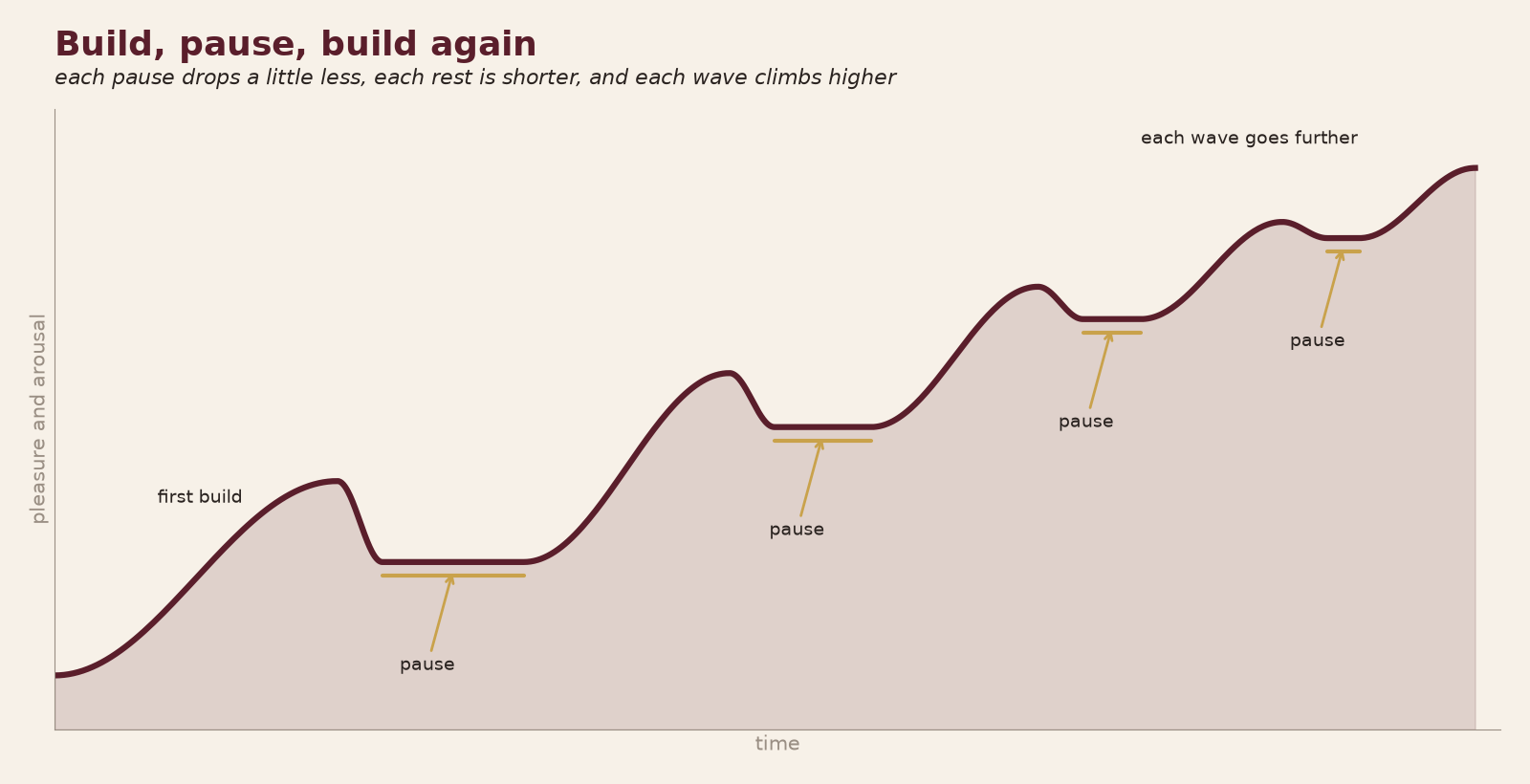
The pause became their favorite thing. They build until they’re near the top, they stop together, breathe, and build again, and each wave goes further than the last. Sex is no longer a straight line from his erection to his finish. It’s a cycle they can stay in for as long as they like.
Same house, different marriage

It’s a Tuesday in February. Nobody stays downstairs answering email. They go up together, and they’re laughing about something one of the kids texted.
She paints with him slowly, smiling, because she knows exactly what she’s doing. He rests at her entrance and they breathe until the waiting is almost unbearable. She draws him in on her breath. They find a rhythm, build it, and stop right at the top, and she laughs, and he feels everything. When they start again, it isn’t her turn or his turn. Her voice is asking for more and his hips are answering, and neither of them could tell you whose pleasure is whose.
A month later, at a dinner party, someone makes the old joke about who has the energy at our age. Rachel and James look at each other across the table, and this time when they laugh, it’s for a different reason, with a glint only the two of them understand. They enjoy the evening. They also leave a little earlier than usual, his hand on the small of her back on the way to the car. Nobody at that table could have said exactly what had changed between them, but everyone in the room could feel that something had.
They were never bad at sex. They were never taught it. Almost nobody is. The good news, for a couple who have learned everything else in their lives, is that this can be learned too, one date night at a time.
This article grew out of the first episode of our podcast, where Dr. Saida and I talk about why we started it and where this work came from. Listen to Episode 1: Why We’re Starting a Podcast.
Frequently asked questions
Why does sex get worse for so many successful, long-term couples?
Because the only sex most of us were taught is friction sex, and friction depends on newness, a firm erection and a body that’s ready right away. When life gets full and bodies change, that model stops working, and nobody teaches the alternative. It isn’t a failure of love or attraction. It’s a missing skill, and the skill can be learned at any age.
Can penetration stop hurting during perimenopause and after menopause?
For many women, yes. Much of the pain at the entrance comes from being entered before the body is ready, and when the receiving partner draws her partner in at her own pace, her body sets the timing. For deeper pain points, 9 Naughty Nights teaches a specific practice: stay still, find the right pressure, breathe in while gently pushing out with the pelvic floor, then relax and let your voice out. Dr. Saida also believes that women who learn this way of having sex can see lubrication, desire and arousal return.
What if he loses his erection at the moment of penetration?
That’s one of the most common things Dr. Saida and I see, and it’s usually anxiety rather than anything wrong with him. In the first date of 9 Naughty Nights, she leads, his erection doesn’t need to be hard, and you pause at the entrance and breathe together until the anxiety turns into anticipation. A soft cock still has a great deal of sensation, and when he feels her drawing him in, the pressure goes and the arousal comes back.
Will this help him last longer?
Yes. In our 2025 study, intercourse moved from under five minutes toward five to fifteen, and the whole experience from five to fifteen minutes toward fifteen to thirty. Men last longer in this method because they feel more, not less: they stop monitoring, use the pause, and ride the cycle of arousal instead of racing to the end.
We've basically given up on sex. Is it too late?
No. Some of the couples we’ve worked with had been together for forty or fifty years. Dr. Saida has seen women in their seventies discover pleasure for the first time. If what stopped you was pain, numbness, erection trouble or simply years of routine, those are exactly what this course works on.
Does it work for same-sex couples?
Yes. We demonstrate with a penis and a vulva, but the skills are breath, pelvic floor, hips, rhythm and responsiveness, and they work for any combination of bodies, including with a strap-on.
Learn the part nobody taught you.
9 Naughty Nights is nine date nights of the education that school, porn and the experts all skipped: how two bodies create pleasure together during sex, at any age. Nine dates, 26 lessons, watched privately at home and practiced together.
Start 9 Naughty Nights →References
- Kasian, S., Désilets, S., & Michael, A. (2025). Integrative sexual wellness… Health, 17, 695–746. https://doi.org/10.4236/health.2025.176045 (Dr. Saida Désilets and Aaron Michael, the method’s creators, are co-authors.)