
It’s late, she’s asleep, and he’s on his phone typing the same five words millions of men type every month: how to make her come.
He’s not a clueless guy. He’s good at things. He learned his work by doing it, he can fix most of what breaks in his house, and the people around him rely on him. In bed he’s attentive and he tries hard. And still, more nights than he’d like, it ends with her stroking his arm and saying, “It’s fine. It doesn’t always happen for me.”
Every part of him wants to solve it. So he reads the lists. A different finger position, a different speed, a toy, a “trick that works every time”.
I want to say this to him, and maybe to you: the intention behind that search is beautiful. You want her to have real pleasure with you. Nothing is wrong with you. You’ve just never been trained in this, and almost nobody has. Most of us figured sex out by trial and error, and trial and error doesn’t teach you a woman’s system of pleasure.
The search itself is part of the problem. “How to make her come” assumes her orgasm is something you do to her, like a button you press. It isn’t. It’s what happens when the right conditions are in place, and those conditions are skills you can learn.
Why most of us misunderstand female orgasm
Most women were taught very little about their own orgasm, and most men were taught less. What fills the gap is porn, rumours and a very narrow picture.
In that picture, orgasm is one thing: a peak, a few contractions, a finish. Classic lab descriptions do centre on rhythmic contractions of the pelvic floor, and that’s useful. It’s also incomplete. Researchers who’ve reviewed decades of definitions describe orgasm as more than a muscle event, with a mental and emotional side that’s hard to measure, and women describe orgasms that feel very different from each other, even within one woman’s own life.
So a lot of women quietly decide they’re “broken” because their experience doesn’t match the script. And a lot of men decide they’re failing because they can’t produce the script.
That’s why I’d swap the question. Not “did you come?”, but “where is your pleasure leading, and can we follow it?”
The goal is what's getting in the way

Here’s what happens when her orgasm becomes the target.
He gets anxious and starts monitoring her. She notices, starts worrying about taking too long, and goes into her head. Both of them leave their bodies. The touch turns mechanical, her breath gets shallow, and the very arousal he’s chasing pulls back.
Pleasure grows when there’s room for it, not when there’s pressure on it. The best lovers I know don’t chase orgasms. They create the conditions where an orgasm becomes much more likely, and they enjoy every minute of getting there.
You can't make her come. You can learn to create the conditions where her body wants to.
Aaron Michael
What an orgasm can actually be
Dr. Saida and I teach orgasm as a shift in awareness, sensation and state. That shift can be small or big, quiet or explosive, emotional or physical, short or long, with contractions or without them.
The physiology matters. Her lived experience matters too. And her pleasure is often bigger than a lab definition. When you stop looking for one specific event, you start noticing how much is already happening, and so does she.
Why many women can't orgasm, or think they can't
Most people assume the problem is not enough stimulation. In real life the reasons are usually more practical than that, and every one of them can be learned.
She’s never been shown her pleasure as a system. Pleasure doesn’t live in one spot. It’s a system: blood flow and engorgement, breath that turns sensation up or down, movement and rhythm that build charge, the pelvic floor working like a gearbox for pleasure, and a nervous system that feels secure enough to stay open. When nobody understands the system, the default is “try harder”, and more intensity without the mechanics often brings numbness or shutdown instead of pleasure.
The definition is too narrow. If only one kind of peak counts, waves without a peak, soft rolling pulses or full-body release get missed or dismissed.
Her body is waiting for intensity. Many people miss the early signs of arousal because they’re waiting for something big. But sensitivity usually comes before intensity. Sometimes the body has also learned to feel less, because sex has been rushed, uncomfortable or disconnected, or because it’s used to only registering strong stimulation. Slowing down and noticing the small signals lets them build.
Her mind isn’t switched on yet. Mental arousal isn’t “thinking sexy thoughts”. It’s anticipation, novelty, permission to want, and the ability to stay with a sensation long enough for it to deepen. Without it, even perfect touch can feel neutral.
She doesn’t feel met. Emotional connection isn’t candles and love songs. It’s feeling seen, desired and respected, free to say yes, no, slower or more, and allowed to be intense without being judged. For one woman that’s tenderness. For another it’s play, power or being claimed. Either way it’s attunement: her nervous system recognising, “I’m met here.”
Technique matters, but it isn't the driver
You can touch someone “perfectly” and get nowhere if her mind isn’t turned on, her body isn’t warmed up, she doesn’t feel secure, or there’s no erotic charge between you.
So the better question isn’t “which move?” It’s “how do I wake up her whole erotic system, and not only her genitals?”
The whole body comes first

Most lovers go straight for the obvious places. It’s like walking into a cathedral and heading straight for one pew without looking up at the stained glass.
Pleasure builds from the outside in. Her shoulders, back, thighs, hips, belly, neck, feet, arms and face. As those wake up, blood moves, skin becomes responsive, anticipation grows and her whole body starts to take part. By the time you touch her clitoris or enter her, her body is already saying, “Yes, take me there.”
Erotic tension is the ingredient most men skip
This is one of the things I teach most: erotic charge is built with space, anticipation, presence and timing, not with friction.
You can see it building. Her breath deepens, her skin flushes, her pupils widen, she leans in, and she moves a little toward your touch. And you can watch it collapse when you rush, when you’re stuck in your head, when nerves take over, or when you run the same routine every time.
A great lover enjoys the build as much as the peak.
Your voice and your eyes are tools
Your voice changes what she feels. A voice from the head sounds mental and detached. A voice from the chest carries connection. A voice from low in the body feels erotic and grounding. Many women can be turned on, or shut down, by voice alone.
Eye contact works the same way. Some women need it to feel desired. Some want less of it at first, some want hungry eyes only near the peak. A skilled lover reads the small signals, the pace, the shifts in her breath and how much intensity the moment can hold.
Rhythm, breath and moving together
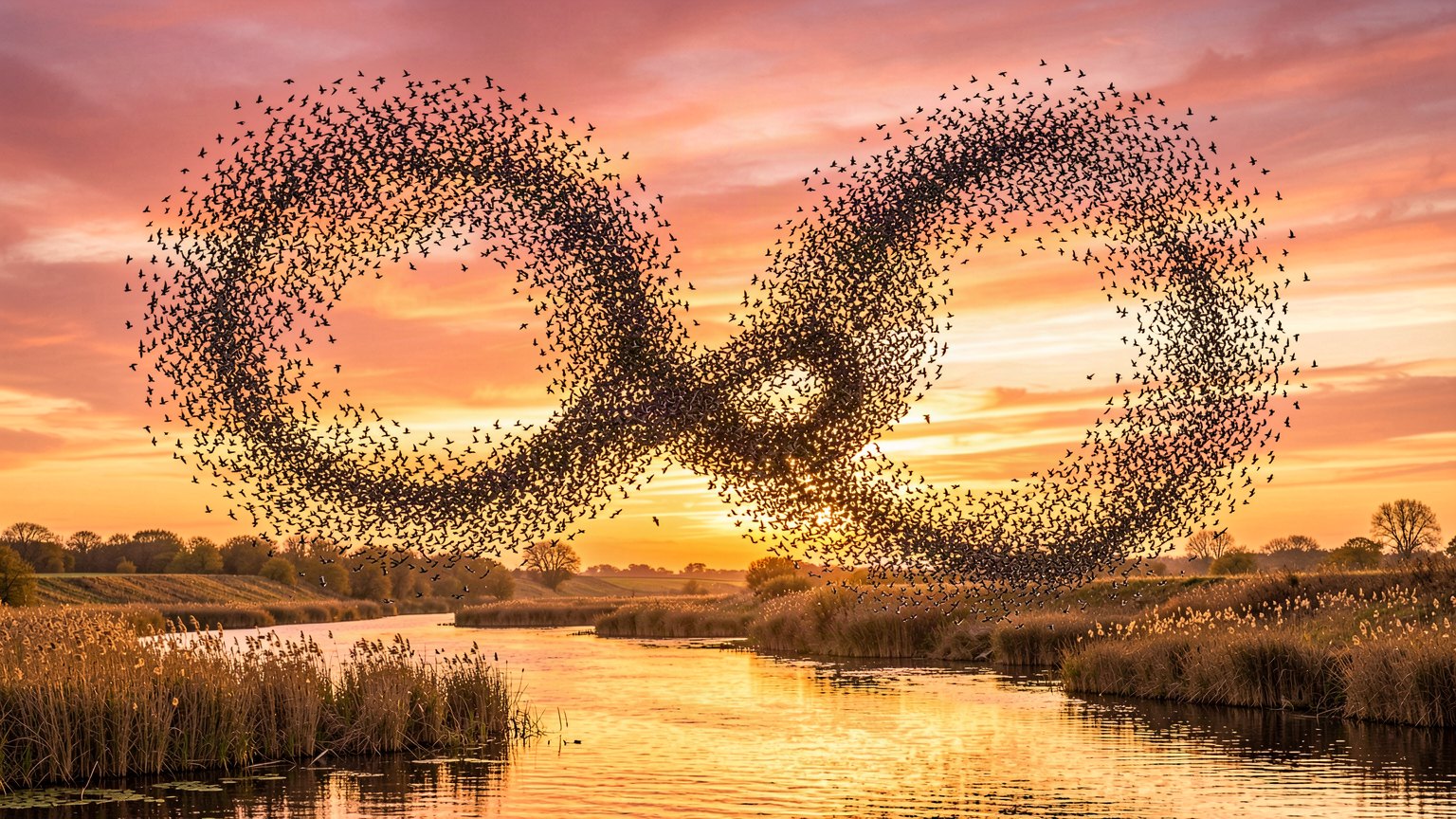
Orgasms rarely come from frantic, disconnected touch. They come from matched breathing, rocking together, a steady rhythm she can trust, and two bodies finding a shared beat, the way dancers do.
That shared rhythm brings security, deeper arousal and a sense of unity, and it lets resistance melt. When your breath and rhythm sync with hers, orgasm becomes far more likely without anyone forcing it.
What about vibrators?
Mainstream advice often stops at “just use a vibrator on her clitoris”. A vibrator can be a good tool. But her pleasure isn’t a device.
When a woman knows her body as a system, breath, blood flow, pelvic floor, mental arousal and whole-body sensation, she gains something more valuable than a reliable trick. She gains sexual confidence, and with it a kind of security that comes from inside: “I can feel. I can guide. I can say yes, no, slower, more. I can stay present.” From there, a toy is an optional extra, not the foundation. And you’re not competing with it. You’re bringing what it can’t: your attention, your rhythm, your voice and your presence.
Flatline orgasms and expansive orgasms
This is one of the most useful distinctions I know.
A flatline orgasm is a sudden peak and a sharp drop. Desire disappears, she disconnects, and it ends with “I’m done, don’t touch me.”
An expansive orgasm comes in waves and rolling peaks. Pleasure lasts, she stays open and connected, and afterwards she’s satisfied and still turned on, wanting more closeness, not less.
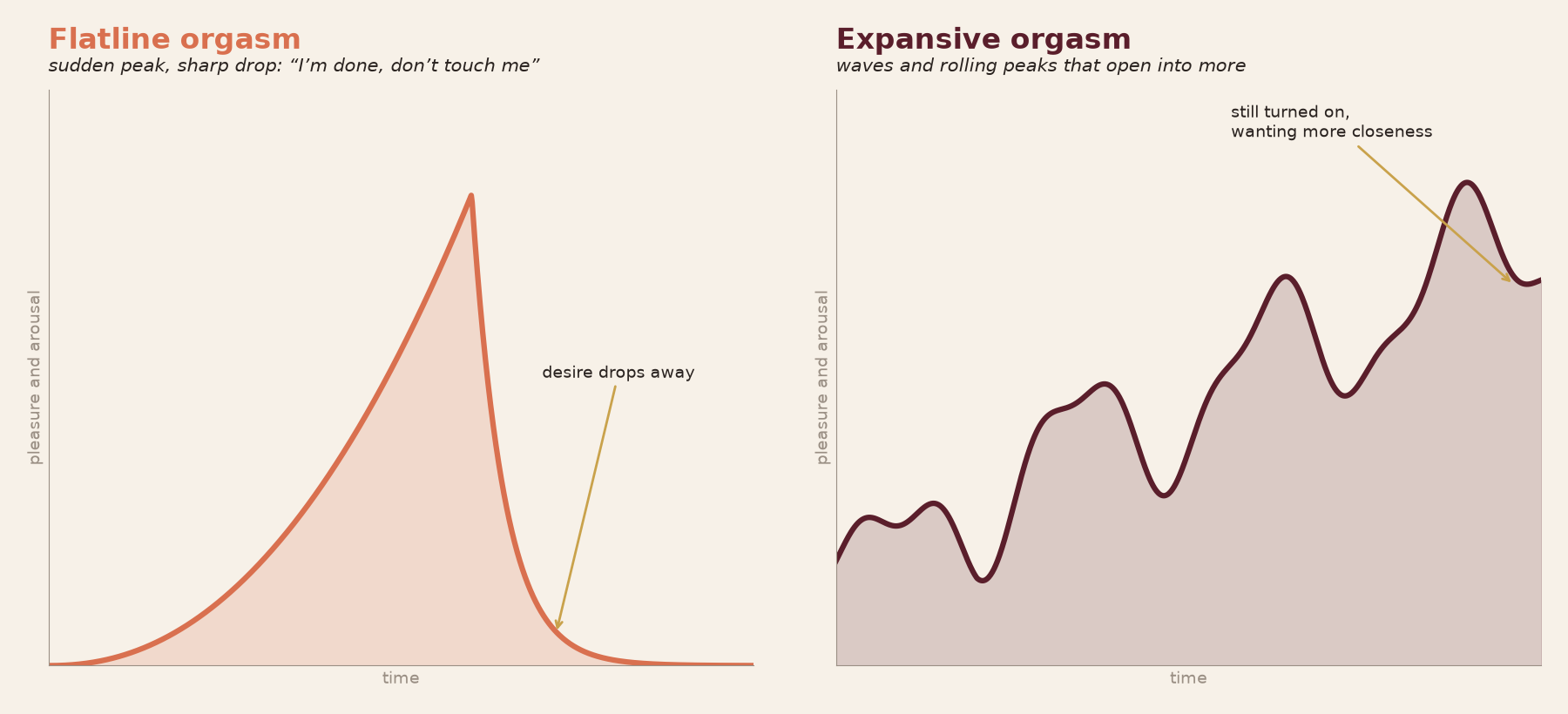
Expansive orgasms tend to happen when her whole body is involved, when she feels secure enough to stay open, when the experience is emotional and sensual as well as genital, and when the giver adapts to her moment by moment. A skilled lover isn’t aiming for one big bang followed by nothing. He helps her into orgasms, soft or wild, that open into more.
So how do you make her come?
You don’t. Orgasm isn’t something you do to her body. It’s something you do with it.
You stir her imagination and wake her body gradually. You build tension and help her feel secure. You use your voice, your breath and your presence, and you involve her whole body. You match her breath, find a shared rhythm, let her guide you when her body speaks, and follow where her pleasure is going. You put pleasure first and let the peak take care of itself.
Here’s what separates an exceptional lover from a merely consistent one. A good lover can repeat what worked last time. An exceptional lover listens to what’s happening right now and helps it unfold. That’s what keeps a long relationship from sliding into routine, and it’s what keeps passion alive for years.
A good lover can repeat what worked last time. An exceptional lover listens to what's happening right now.
Aaron Michael
That's a skill, and skills can be trained
If you’re the kind of man who learned most things by doing them, here’s the good news. None of this is talent, and none of it is a personality trait. It’s a set of skills, taught in the right order, practised in your own bedroom.
That’s why I made Bring Her To God. It’s my course for men who want to recognise, awaken and work together with a woman’s pleasure. It’s 52 video lessons, about five hours in all, in nine levels that follow the same order as her body: blood flow and warming her up, her nerves and pleasure pathways, arousal and getting her wet, the clitoris, the entrance, entering her, moving your hips, and touching her where no one has before. There’s also a short “getting started” section for when you want something useful tonight.
1
Getting started
What to watch first if you want something useful tonight.
2
Level 1: Keep her moving
Blood flow, and why warming her body up comes first.
3
Level 2: Awaken her nerves
Her pleasure pathways, and how to wake them in layers.
4
Level 3: Warm her up
Arousal, getting her wet, and building real desire.
5
Level 4: The clitoris
How to touch it in a way that builds instead of numbs.
6
Levels 5 and 6: The entrance
Taking your time at her entrance, and entering her so she draws you in.
7
Level 7: Your hips
Moving your hips so she moves with you.
8
Level 8: Squirting
What it is, and how to make room for it.
9
Level 9: Deeper
Touching her where no one has before.
You learn at your own pace, privately, and you keep it.

What men say
A man who thought things were already fine wrote, “Before the course, I thought I had good sex with my girlfriend, but Aaron really taught me how creating an intimate connection changes everything. With a few simple tricks like breathing techniques and using different angles, our sex life has had a massive boost.”
Another was surprised by how practical it is: “I’m really surprised how much practical knowledge there is in this course, and it’s made really easy to understand and do in person. Sometimes, it takes a little time for me to process what I’ve learned, but then I get this Aha moment when my girlfriend is reacting similarly to how Aaron describes it.”
A husband from one of our couples groups put the shift simply: “not having something in your head, trying to perform… but be there, be with your partner, have the connection, and really be present and in the moment. … You don’t have to get it right the first time.”
Dr. Saida and I also wanted more than stories, so we designed and published a peer-reviewed study of the method behind our courses. Forty-three couples, 86 people, spent eight weeks learning our partnered protocol. Their overall sexual satisfaction rose 36.4%, communication about sex improved 15.5%, and women reported better orgasm, arousal and satisfaction. It was a single-group study without a control group, so it shows what changed for the couples who did the work, not a promise for every couple. Bring Her To God teaches a man his side of that same approach to a woman’s pleasure.
The 2025 study, 43 couples, eight weeks
+36.4%
overall sexual satisfaction
+15.5%
communication about sex
86
people, 43 couples
8
weeks learning the method
Kasian, Désilets & Michael (2025), Health 17. Co-authored by the method's creators. Single-group study, no control group.
Bring Her To God
Learn the system, not the trick
Bring Her To God is 52 lessons in nine levels that follow her body, from the first touch to the deepest. Private, at your own pace, yours to keep.
See Bring Her To God →Back to him

Picture him a few weeks later. He’s stopped searching for the trick. He starts slowly, far from where he used to start, and he notices when her breath changes. He uses his voice. He lets the tension build and doesn’t rush to cash it in. When her hips start to move, he follows them. And when it comes, it doesn’t end things. She pulls him closer.
He was always capable. He just hadn’t been trained. Now he has been.
Want the full conversation? Dr. Saida and I talk through all of this, explicitly, in episode 4 of the Embodied Love Lounge podcast, “How To Make Her Cum”.
Frequently asked questions
How do I make her come?
You can’t do it to her, but you can create the conditions for it: a slow, whole-body warm-up, real erotic tension, a rhythm she can trust, matched breathing, your voice and your full attention. Let her body guide you, and put pleasure before the peak.
Why can't my partner orgasm with me?
Usually it isn’t a lack of stimulation. Common reasons are a rushed warm-up, pressure to perform, her mind not being switched on yet, not feeling fully met, or a narrow idea of what an orgasm “should” be. All of these can change with skill and time. If she has pain during sex, she should see a doctor.
Are there different types of female orgasm?
Women describe very different experiences: waves without a peak, rolling pulses, full-body release, quiet or explosive peaks. Researchers who’ve reviewed orgasm definitions describe it as more than a set of contractions. We find it more useful to follow her pleasure than to label it.
Is it bad if she needs a vibrator?
No. A vibrator can be a useful tool. It works best as an optional extra on top of knowing her body as a system, not as the only way in. Your attention, rhythm and voice offer things a device can’t.
What is an expansive orgasm?
It’s how we describe an orgasm that comes in waves and leaves her open and wanting more connection, rather than a sharp peak followed by “don’t touch me”. It’s more likely when her whole body is involved and she feels secure enough to stay open.
What's in Bring Her To God?
52 video lessons, about five hours in total, in nine levels that follow a woman’s body, plus a short “getting started” section. You learn privately, at your own pace, and keep access.
Learn the system, not the trick.
Bring Her To God is Aaron Michael’s course for men who want to recognise, awaken and work with a woman’s pleasure. 52 lessons in nine levels, at your own pace.
Start Bring Her To God →References
- Mah, K., & Binik, Y. M. (2001). The nature of human orgasm: a critical review of major trends. Clinical Psychology Review, 21(6), 823–856. https://pubmed.ncbi.nlm.nih.gov/11497209/
- Jannini, E. A., Buisson, O., & Rubio-Casillas, A. (2014). Beyond the G-spot: clitourethrovaginal complex anatomy in female orgasm. Nature Reviews Urology, 11, 531–538. https://doi.org/10.1038/nrurol.2014.193
- Kasian, S., Désilets, S., & Michael, A. (2025). Integrative sexual wellness… Health, 17, 695–746. https://doi.org/10.4236/health.2025.176045 (Dr. Saida Désilets and Aaron Michael, the method’s creators, are co-authors.)